


Fire risk assessments
A suitable and sufficient assessment by a registered assessor, and a clear plan for what to do next.
Your duty, made clear
The Responsible Person must make sure a suitable and sufficient fire risk assessment is in place.
That is usually the employer, the owner or the managing agent. We carry out the assessment, explain what we found and set out what needs doing, in what order and by when.
Our reports are written to be relied on. Each one is structured, evidenced and reasoned, so an insurer, a Fire and Rescue Service, Building Control or an auditor can follow how every conclusion was reached.
Buildings we assess
Commercial, residential, care and education premises. The linked types each have a page on what the law asks for.
- Offices and commercial premises
- Shops, cafes, restaurants and showrooms
- Factories, industrial units and warehouses
- Care homes and supported living
- Children's homes
- Purpose built and converted flats
- HMOs and managed residential portfolios
- Schools and academies
- Places of worship and community halls
- Leisure and sports venues
Fire risk assessments in LondonWhat a fire risk assessment costs
What the assessment covers
How a fire could start, how it could spread, and how people would get out.
What you receive
A report written to be read by an inspector, an insurer or an auditor. These pages come from an assessment of a fictional mixed use building.
Fictional premises. Not an assessment of any real building.
Significant findings first
Each action with a priority and a timescale.
The reasoning behind it
So anyone reviewing it can follow the conclusion.
Limitations stated
Anything not seen is recorded, not assumed.
Held in your portal
With the date the next review is due.
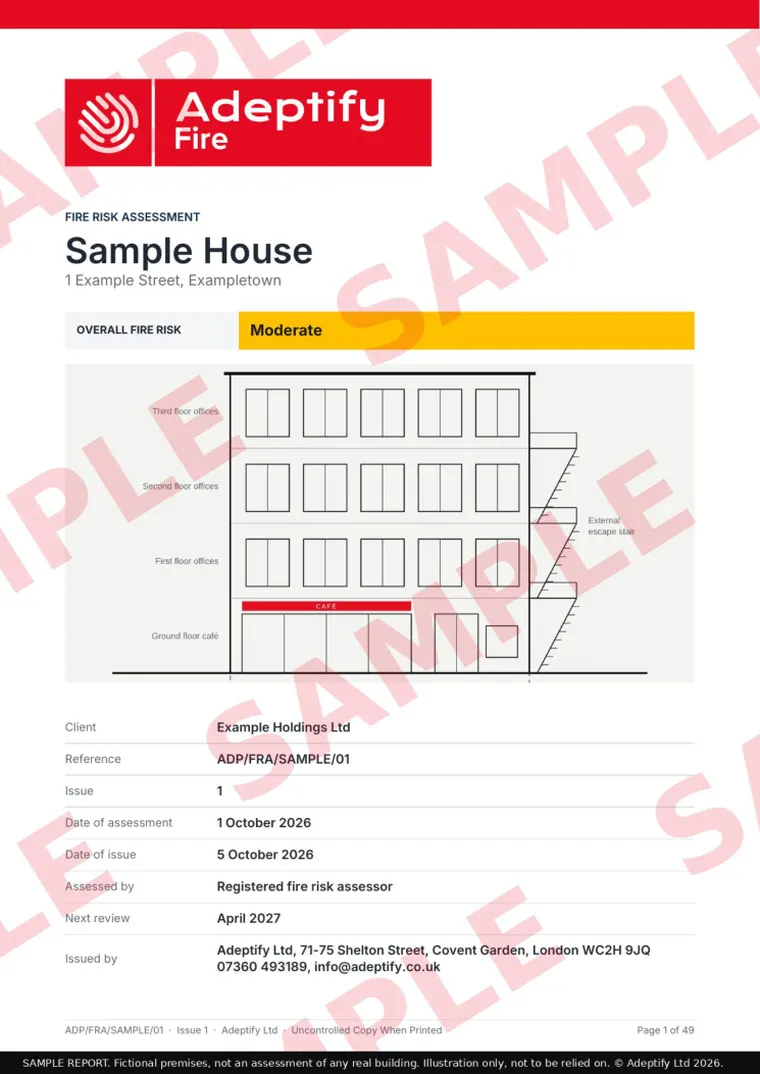 Cover
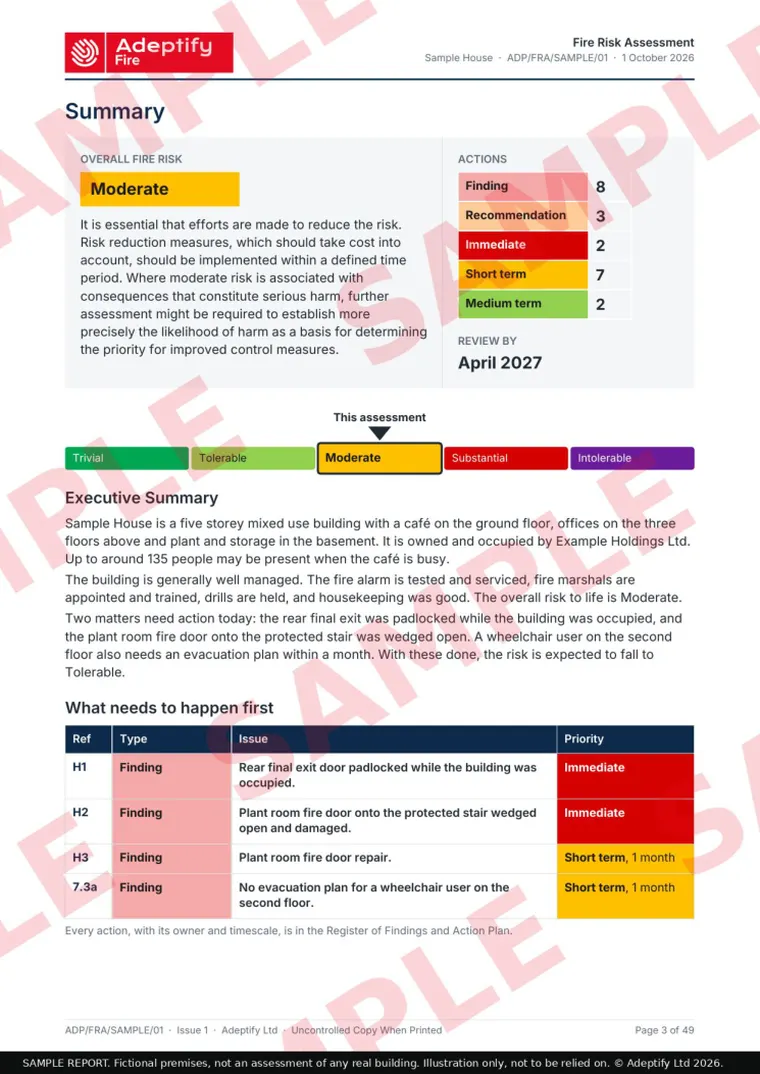 Summary
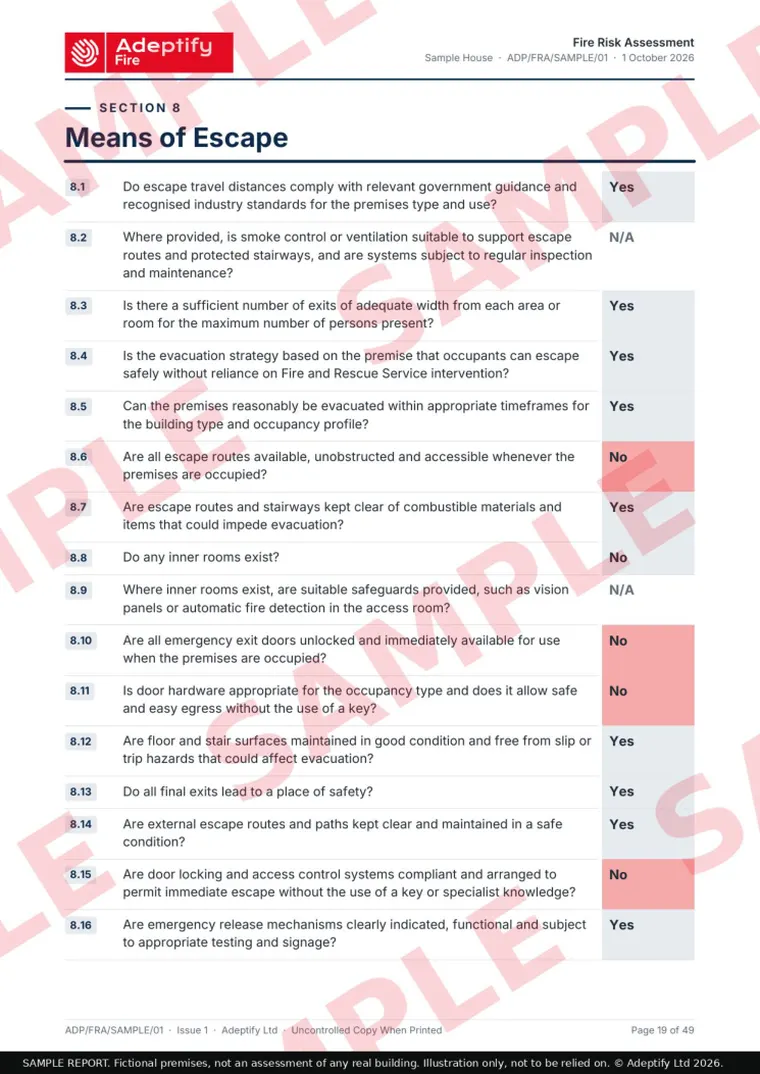 Means of escape
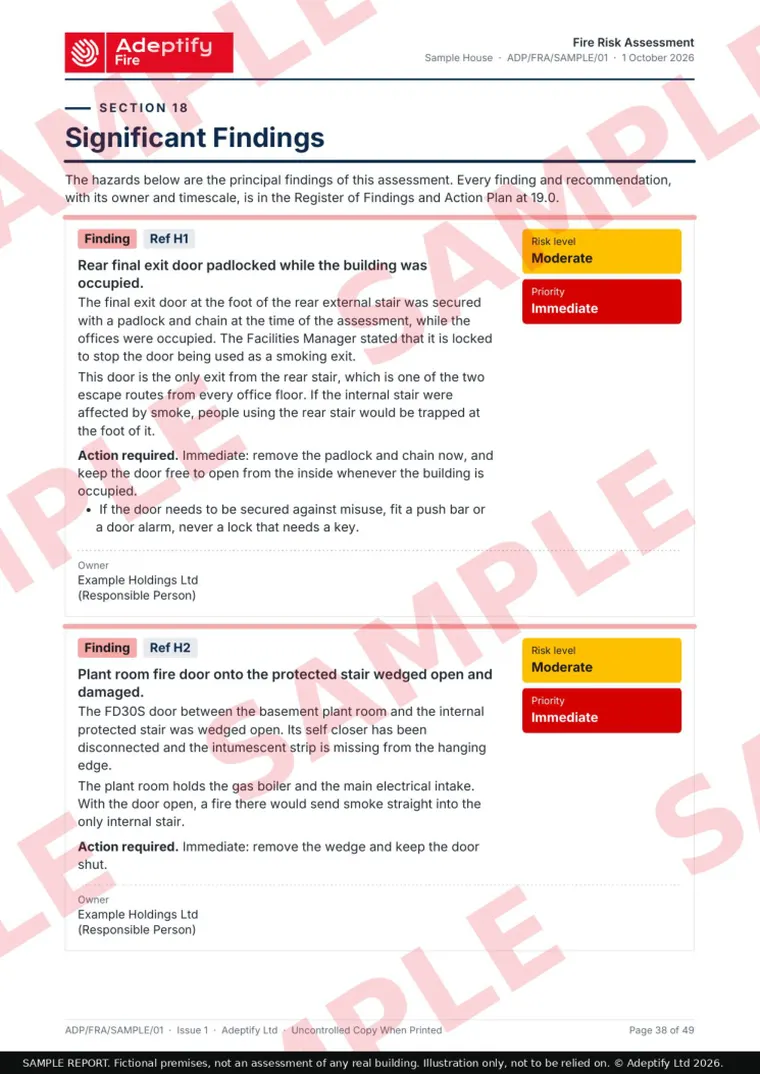 Significant findings
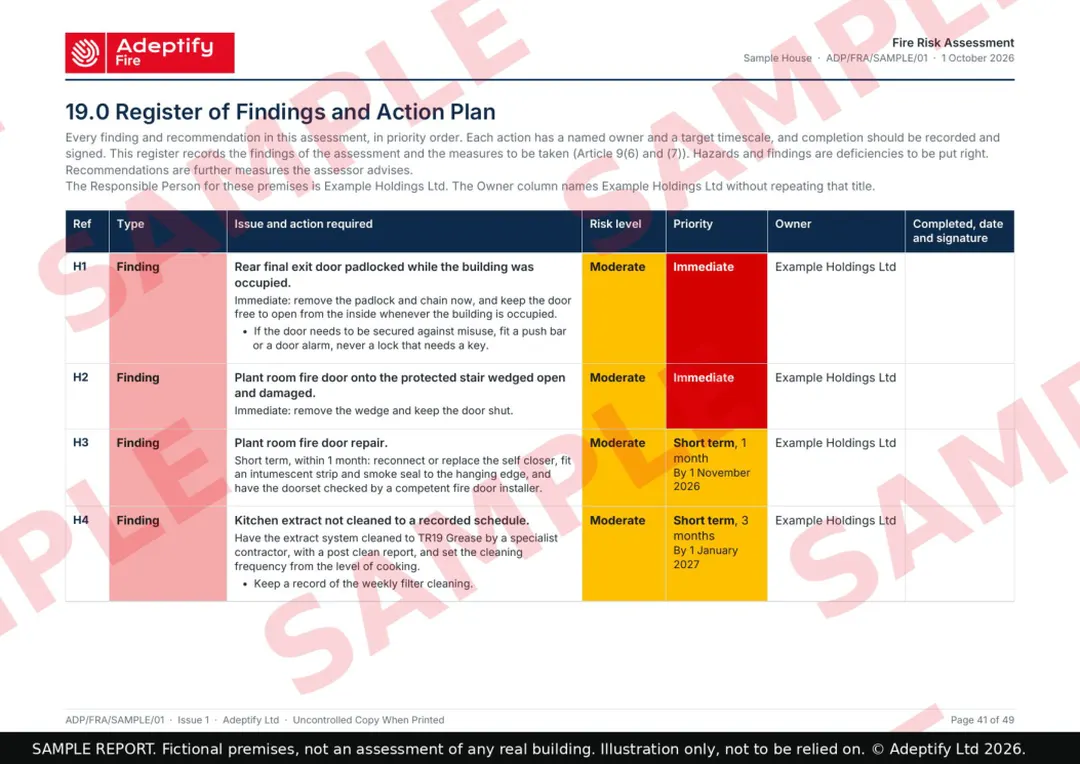 Action register
Your Adeptify Fire Portal
Every report and every review date for every building, in one place. Nothing to chase and nothing to file.
Every report in one place
Current and previous assessments for each building, ready to download as a PDF.
Review dates tracked
Each building shows when its next review is due, and we remind you before it falls due.
Ready when someone asks
An inspector, insurer or managing agent asks for your fire risk assessment. It takes a minute to send.
Screens show a fictional client.
How it works
- Tell us about itAddress, use, size and your deadline.
- Fixed quotePrice and issue date agreed before anything is booked.
- InspectionThe whole building, walked in full.
- Report issuedUploaded to your portal with the review date.
Who carries it out
An assessor registered on the National Fire Risk Assessor Register at Intermediate level.
 Membership 101290
Common questions
Ask us directly and you will get a straight answer.
020 8194 2494info@adeptify.co.ukPage last reviewed .
What is a fire risk assessment?
A fire risk assessment is a structured review of a building that identifies how a fire could start, who would be at risk and whether the fire precautions are adequate. It ends with a prioritised plan of actions. The Regulatory Reform (Fire Safety) Order 2005 requires the Responsible Person for most non-domestic premises, and for the common parts of blocks of flats and HMOs, to have a suitable and sufficient one.
Who can carry out a fire risk assessment?
The Responsible Person can carry it out or appoint someone to do it, but whoever does it must be competent, with enough training, experience and knowledge for the type of building. In England the name of the person who carried it out must be recorded. Our assessments are carried out by an assessor registered on the National Fire Risk Assessor Register at Intermediate level.
Do I need a fire risk assessment?
If you are responsible for a workplace, a building open to the public, or the common parts of a block of flats or an HMO, the Regulatory Reform (Fire Safety) Order 2005 requires one. In England the whole assessment must now be recorded, along with who carried it out.
How often should it be reviewed?
The law sets no fixed interval. It must be reviewed regularly and whenever it may no longer be valid, for example after building work, a change of use or a fire. Most premises are reviewed every year. Your report sets the next review date.
What is the difference between a fire risk assessment and a fire strategy?
A fire strategy sets out how the building is designed to keep people safe in a fire. A fire risk assessment checks how the building, its systems and its management are performing today. Many buildings need both, and the two should agree.
Is the inspection intrusive?
No. It is visual and non-destructive. Anything that could not be seen, or that needs specialist testing, is stated in the report with what should happen next.
Do you assess private houses?
No. We assess workplaces, premises open to the public and the common parts of residential buildings, not single private dwellings.
Which areas do you cover?
All of England and Wales. We work nationwide, across London and the South East, the Midlands, the North West, Yorkshire, the South West and Wales, for single buildings and multi-site portfolios.
Tell us about your building.
Send the address and what you need. We will come back to you with a fixed quote.